
Are your ticket discounts training audiences to wait?
Early bird tickets and promo codes can boost demand, but they may also teach audiences to wait. Explore how discount pricing influences booking behaviour and long-term audience value.
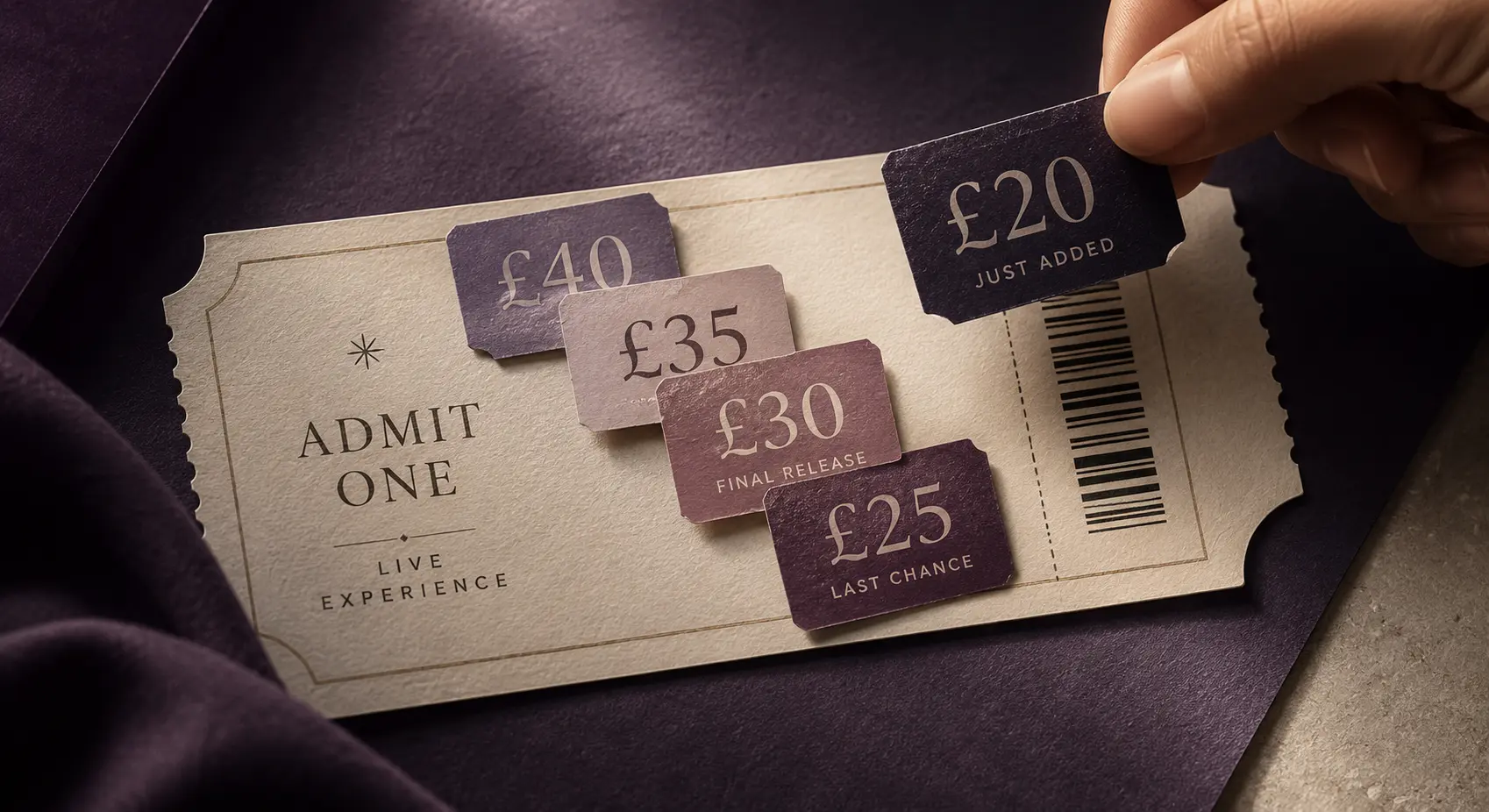
Early bird tickets and promo codes can build demand quickly. But they can also teach audiences to delay booking, expect lower prices, and question what a ticket is really worth.
The issue is not whether discounts work. They often do. The real question is what behaviour they're training your audience to repeat next time.
When customers repeatedly see tickets discounted closer to an event, they learn that the advertised price isn’t the real one, booking early carries little benefit, and waiting produces a better deal. A strong pricing strategy should reward the behaviours an organisation actually wants — early commitment, repeat attendance, subscription renewal — not the opposite.
The deal that never really ends.
In the UK, Domino’s offers a familiar version of this problem. Voucher codes, “Two for Tuesdays,” and an in-app deal finder mean that, for many customers, paying the advertised menu price is the exception rather than the rule. When a discount is almost always available, it stops functioning as a discount. It becomes the price.
Once customers depend on discounts, breaking the habit is a lot harder than it seems. In 2012, the US retailer J.C. Penney replaced its near-constant vouchers and markdowns with simpler everyday pricing. Revenue fell by approximately 25% in the first year, and the company eventually reversed course — customers had grown attached not just to lower prices, but to the feeling of securing a deal.
That lesson applies directly to event ticketing. Every early bird offer, last-minute release, and promotional code teaches audiences what a ticket is really worth, and which behaviour gets the best price. The immediate sales uplift may be useful. The long-term lesson may not be.
Why a discount is never just a discount.
Behavioural economist Richard Thaler distinguishes between two sources of value in a purchase: acquisition utility, the value of the product itself, and transaction utility, the satisfaction of believing you got a good deal.
Consider two identical theatre tickets: one costs £15; the other costs £15 but is advertised as reduced from £25. Same seat, same show — but the discounted ticket feels more valuable because it creates a stronger sense of getting a bargain. That feeling depends on a reference price: what a customer believes something should cost. Once established, it’s hard to shift.
Research into “coherent arbitrariness” found that even a fairly random starting price can shape what someone is willing to pay. Once that price sticks, people judge everything else against it — even though there was nothing meaningful about how it was set.
For an arts organisation, a regularly discounted matinee may do more than fill seats — it resets what audiences believe that matinee is worth. When full price returns, it doesn’t feel normal. It feels like an increase.
How ticket discounts influence booking behaviour.
The risk grows when price and booking time are connected. Offer early bird tickets months out, standard pricing in the main window, and cheaper promotional tickets just before the show, and audiences learn that waiting beats committing early. Patrons begin to “hold out” for an offer — and when advance sales look weak, the organisation discounts again, reinforcing the cycle:
audiences expect a late discount;
more people delay booking;
advance sales weaken;
another promotion is released;
waiting is rewarded again.
This is not flexible pricing. It is a booking habit being trained — and it can mean discounting tickets for people who would otherwise have booked early at full price.
What arts organisations can learn from pricing research.
Research shared by arts and culture consultancy Baker Richards shows how the journey to a higher average ticket price can affect audiences very differently. Two organisations each raised their average price paid by close to 30% over several years. The one that phased the increase in gradually kept strong audience growth. The one that pushed a similar rise through in a single year, using aggressive dynamic pricing, lost bookers significantly — and only recovered once its average price eased back the following year. The eventual price increase was the same. The audience experience was not.
Ticket pricing decisions shouldn’t be judged on average yield alone. Worth monitoring too: how many people are booking, how far ahead, what percentage pay full price, whether first-time buyers return, and whether discounted customers later buy without an offer. A promotion can fill seats today while quietly weakening booking confidence tomorrow.
When discounts make sense.
This is not an argument against discounting altogether — only against discounting without a clear, consistent reason. It works well when tied to a behaviour the organisation genuinely values:
Early bird pricing rewards commitment.
Membership pricing rewards a relationship rather than a one-off purchase.
Access pricing removes a genuine financial barrier.
Group and family tickets reflect the economics of a bigger booking.
Targeted development offers bring a defined new audience in.
The problem was never the lower price. It is the absence of a clear, consistent reason for it.
A simple test for your pricing strategy.
Ask whether a loyal audience member could explain their price in one sentence. “I booked early” is clear. “I’m a member” is clear. “This is an access ticket” is clear. “I waited for a promotional email” is also clear — just maybe not the behaviour you meant to reward. When customers can’t follow the logic, they are more likely to distrust the headline price and wait for a better one.
How to discount without devaluing your tickets.
Before launching another promo code, ask:
What behaviour are we rewarding — early commitment, loyalty, re-attendance, group bookings, or access?
Could a later offer undercut an earlier one, making early buyers feel they got it wrong by committing sooner?
Which customers actually need the discount? Avoid discounting supporters who were already going to book.
What are we measuring beyond ticket volume? Track booking lead time, full-price conversion, and repeat behaviour — and where possible, compare total income across similar performances with and without the discount.
Is the offer part of a consistent structure audiences can actually follow, without studying every email?
The takeaway.
Ticket discounts do not automatically make audiences less valuable. Unstructured ones can. When promotions are unpredictable, undercut earlier prices, or appear whenever sales dip, they teach audiences to wait — weakening advance sales, denting confidence in the full price, and making revenue harder to forecast.
Effective pricing rewards the behaviours an organisation actually wants: early commitment, repeat attendance, membership, long-term engagement. That takes visibility across a whole season, not just one event.
Little Box Office gives arts, culture, and events organisations a clearer view of who’s booking, when, and what they’re paying — turning ticket pricing decisions into something based on evidence, not habit.
FAQs.
Published on: